Smartious Virtual Lab: 3D science practicals you do with your own hands
A full school laboratory in the browser. Open the apparatus cupboard, set up your bench, rinse the burette, read the meniscus at eye level and record real readings, then turn them into a results table, a graph and a lab report. Try a complete titration below for free, no sign-up needed.
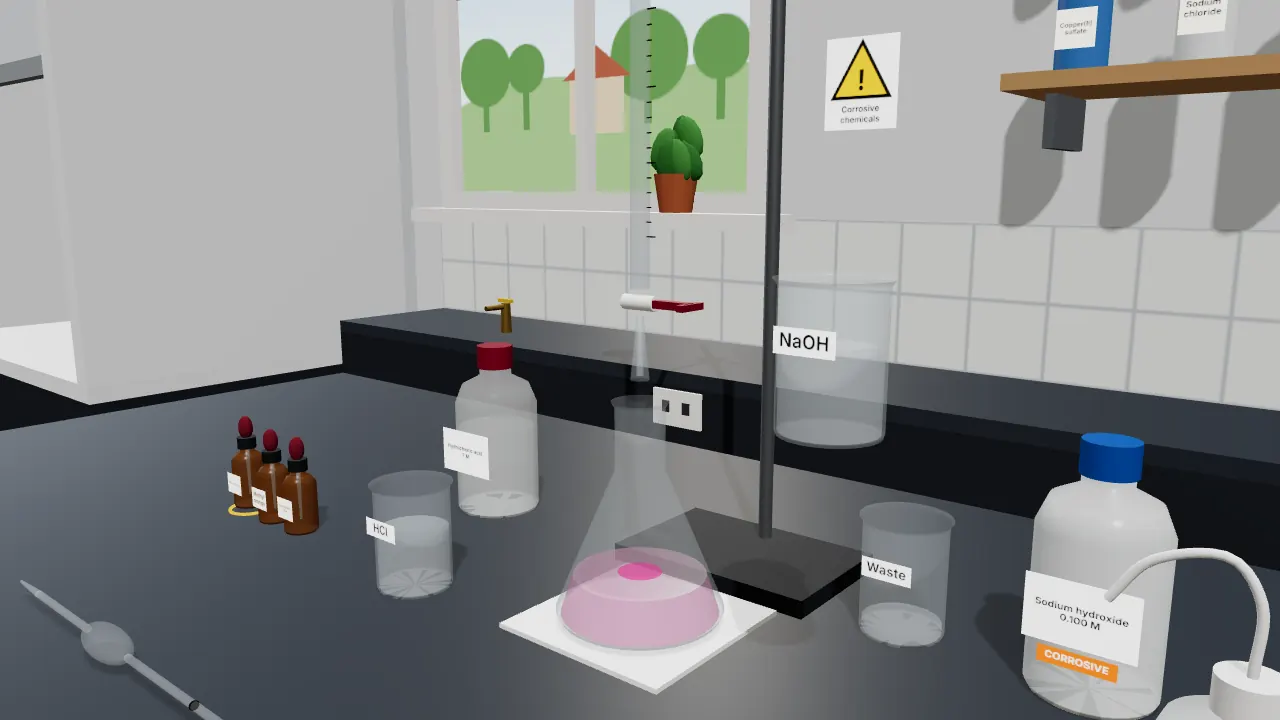
Try it now: an acid–base titration in 3D
Find the concentration of an unknown acid: set up the bench, rinse and fill the burette, pipette 25.0 cm³ of acid, add the indicator, titrate to the end point and check your answer. Free, with no sign-up.
A real laboratory, not a slideshow
Real technique, not just buttons
Students wear goggles, rinse the burette with the alkali, remove the funnel, expel the air bubble, swirl the flask and read the scale square-on. Skip a step and the readings change the way they would at a real bench.
Every reading has an uncertainty
Burettes read to 0.05 cm³, micrometers have zero errors, meters settle and stopwatches need resetting. Students learn to record what the instrument shows, to the right precision.
From bench to lab report
Each practical runs in the order of a school lab: plan, experiment, results table, graph with a line of best fit, analysis, conclusion and evaluation, then a printable report.
Set up your own bench
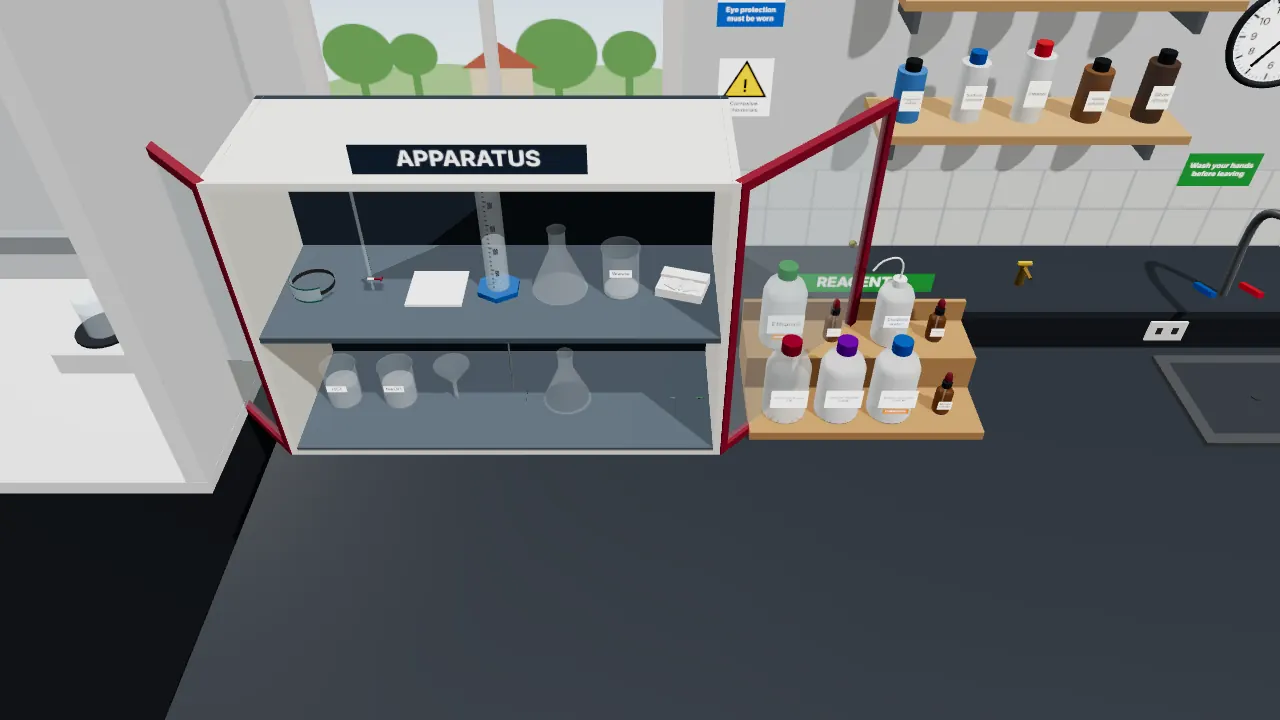
Open the apparatus cupboard, carry each item to the bench and take the right reagents from the rack. Choosing the apparatus is part of the skill.
Marked by teachers
Teachers assign practicals, see every action a student took, and mark the report with the rubric. Technique, readings and answers are checked automatically first.
Works on modest devices
It runs in the browser on a laptop, tablet or phone, with a low-graphics mode and a clear 2D view for older devices. Nothing to install.
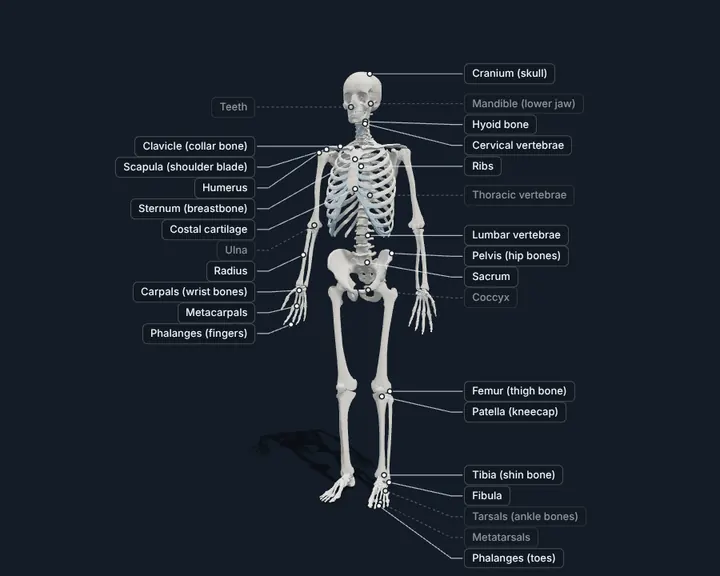
The human skeleton and bones in 3D
The human skeleton
A complete adult skeleton from real anatomical data. Every bone is named, from the cranium to the toes, with a self-test on 28 bones and groups.
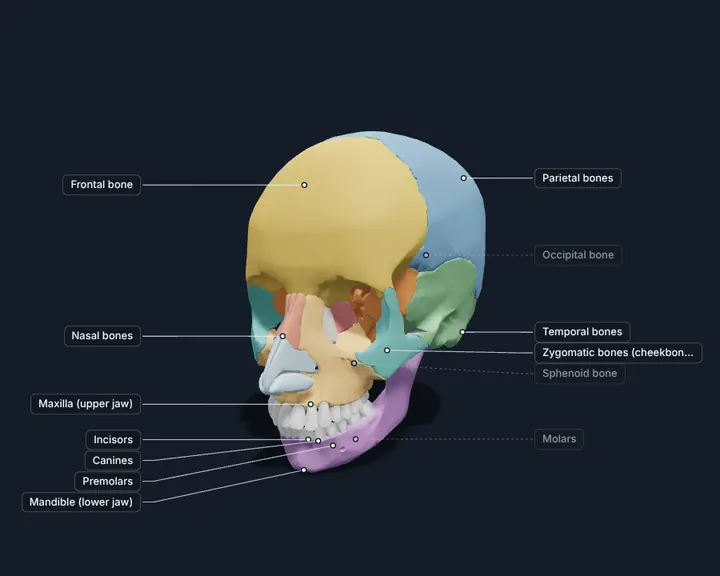
The skull and teeth
Each cranial bone in its own colour. Open the jaw to see incisors, canines, premolars and molars.
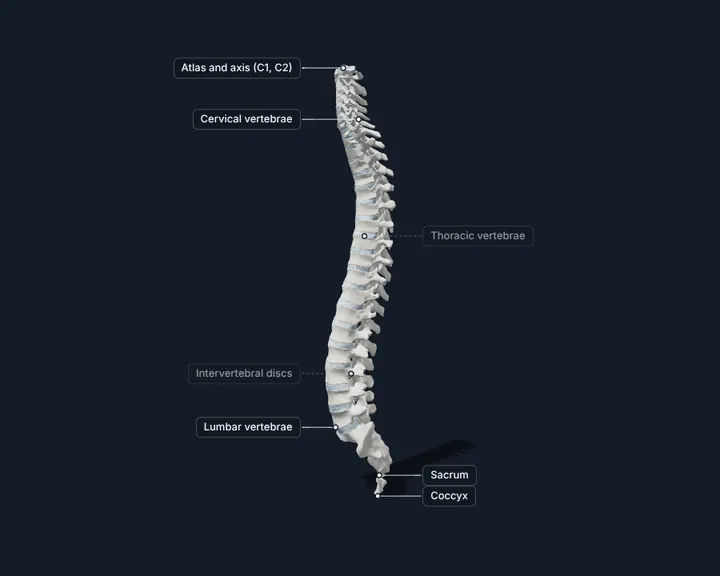
The vertebral column
Cervical, thoracic and lumbar vertebrae, the sacrum, coccyx and the discs between them.
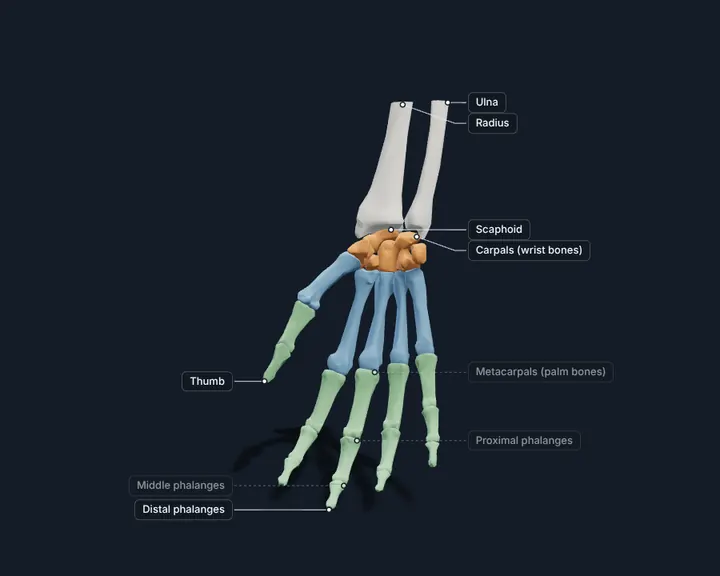
The hand and wrist
All 27 bones of the hand: carpals, metacarpals and phalanges.
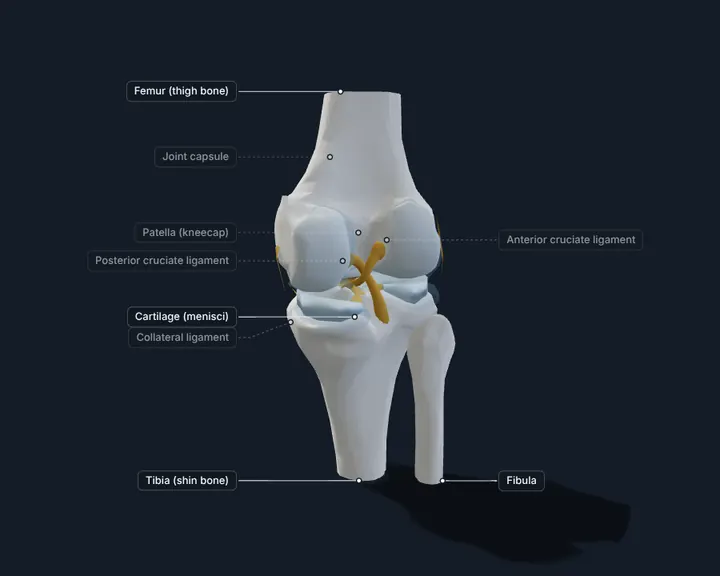
The knee: a hinge joint
Femur, tibia and kneecap with cartilage and ligaments. Open the joint, then compare it with the hip, a ball and socket joint.
3D models for biology and physics
- The human heart: Transport in animals
- The human skeleton: Movement and support
- The human heart: Transport in animals
- Organs of the chest and abdomen: Human organ systems
- The human brain: Coordination and response
- The muscular system: Movement and support
- The knee joint: Movement and support
- The hip joint: Movement and support
- The human skull: Movement and support
- The arm: biceps, triceps and elbow: Movement and support
- The vertebral column: Movement and support
- The hand and wrist: Movement and support
- The reflex arc: Coordination and response
- Breathing and gas exchange: Gas exchange in humans
- The female reproductive system: Reproduction in humans
- The male reproductive system: Reproduction in humans
- The human eye: Coordination and response
- Animal cell: Cell structure
- Plant cell: Cell structure
- Saturn V rocket: Forces and motion: rockets
- Apollo lunar module: Space exploration
- Perseverance Mars rover: Space exploration
- Curiosity Mars rover: Space exploration
- Ingenuity Mars helicopter: Space exploration
- International Space Station: Gravity and orbits
- Hubble Space Telescope: Space and telescopes
- D.C. electric motor: Electromagnetic effects
- Four-stroke petrol engine: Energy and machines
Makes practical exams easier for IGCSE, A Level and IB students
Practical papers reward skills that only come with practice: reading instruments to the right precision, drawing up a results table, plotting a graph with a line of best fit, finding a gradient and judging uncertainty. The Smartious Virtual Lab lets students rehearse every step of a practical, as often as they need, before the real exam.
Cambridge IGCSE (Chemistry 0620 · Biology 0610 · Physics 0625)
Helps with Paper 5 (Practical Test) and Paper 6 (Alternative to Practical).
Students carry out the investigations that come up again and again: rates of reaction with the disappearing cross, energy from burning ethanol, electrolysis of copper(II) sulfate, titration, light intensity and photosynthesis, temperature and amylase, diffusion into agar cubes, osmosis in potato and respiration in yeast. Each ends with a results table, a graph and the method, accuracy and improvement questions that Paper 6 asks.
Pearson Edexcel International GCSE (Chemistry · Biology · Physics)
Helps with the practical questions in the written papers.
Edexcel examines practical work through questions on method, readings, results and evaluation. Doing titration, rates, electrolysis, osmosis, enzymes, photosynthesis and Ohm’s law on a 3D bench gives students the first-hand experience those questions assume.
Cambridge AS & A Level Physics (9702)
Helps with Paper 3 (Advanced Practical Skills) and Paper 5 (Planning, Analysis and Evaluation).
67 practicals across every chapter, from the spring constant and resistivity to capacitor discharge, magnetic fields and the Planck constant. Students read instruments to their real precision, deal with zero errors, process data into reciprocals or logarithms for a straight-line graph, draw best-fit and worst acceptable lines to find a gradient and its uncertainty, and write planning answers for the Paper 5 investigations. Chemistry students practise titration to concordant titres.
Pearson Edexcel International A Level (Physics · Chemistry · Biology)
Helps with the practical skills papers (Units 3 and 6 in Physics).
The same skills the practical units test in writing: planning a method, taking measurements, calculating uncertainties, plotting and using graphs, and evaluating results, rehearsed on a full 3D bench instead of only on paper.
IB Diploma Programme (Biology · Chemistry · Physics)
Helps with the Internal Assessment: the scientific investigation, 20% of the final grade.
The IA is marked on research design, data analysis, conclusion and evaluation. In the lab, students collect real data with uncertainties, plot graphs with error bars and a gradient uncertainty from the worst acceptable line, and evaluate weaknesses and improvements: the habits a strong IA needs. The 78 practicals are also a source of tried and tested investigation ideas.
Cambridge, Pearson Edexcel and the IB set and mark their own practical assessments. The Virtual Lab is practice that builds the skills those assessments test; it does not replace the practical work a school or examination board requires.
Makes learning easy for KCSE and CBE science students
Many students meet a burette or a voltmeter for the first time in the exam room. The Smartious Virtual Lab lets them practise the same practical skills before they get there, as often as they like, with instant feedback on technique.
Chemistry
Volumetric analysis by titration: rinsing, pipetting, reading the burette and getting concordant titres. Rates of reaction, energy changes from burning fuels and electrolysis.
Biology
Osmosis and diffusion, the effect of temperature on enzymes, photosynthesis and respiration. The 3D skeleton, skull, spine and joints for support and movement, plus the heart, eye, brain and cells.
Physics
Measuring with vernier calipers and micrometers, Ohm’s law, resistance of a wire, series and parallel circuits, lenses, pendulums and springs, and plotting and reading graphs.
CBE Junior and Senior School
Learners on the STEM pathway can explore a full laboratory in 3D: apparatus, safety and the scientific method, even where a school laboratory is shared or still being equipped.
The Virtual Lab is a practice tool: it helps any student build practical skills, and it does not replace the practical work set by KNEC or any examination board.
All 78 virtual practicals
Chemistry
Core practicals
- Acid–base titration
IGCSE · Rates of reaction
- Concentration and rate: the disappearing cross
- Temperature and rate: the disappearing cross
IGCSE · Energy changes
- Energy from burning ethanol
IGCSE · Electrolysis
- Electrolysis of copper(II) sulfate
Biology
Core practicals
- Osmosis in potato tissue
IGCSE · Plant nutrition
- Light intensity and photosynthesis
IGCSE · Enzymes
- Temperature and amylase
IGCSE · Movement into and out of cells
- Diffusion into agar cubes
IGCSE · Respiration
- Temperature and respiration in yeast
Physics
Core practicals
- Ohm's law
AS & A Level · Using apparatus
- Density of water
- Spring constant of a spring
- Resistance of a metal wire
- Cylinder rolling down a ramp
AS & A Level · Limitations and improvements
- Cooling of water in a polystyrene cup
- Stretching a loaded rubber band
- Mass of a balanced metre rule
AS & A Level · Kinematics and dynamics
- Acceleration of connected masses
- Energy and amplitude of a pendulum
- Range of a horizontally launched ball
- Terminal velocity of balls falling through water
AS & A Level · Forces, work and energy
- Load position and the forces on beam supports
- Density of a metal sample
- Equilibrium of a pivoted wooden strip
- Kinetic energy and work against friction
AS & A Level · Matter and materials
- Young modulus of nylon
- Young modulus of steel using a spring
- Water pressure and flow rate
AS & A Level · Electric current, potential difference and resistance
- Power and resistance of a filament lamp
- Resistors in series
- Resistors in parallel
AS & A Level · Resistance and resistivity
- Resistivity of the metal of a wire
- Internal resistance of a dry cell
- Potential divider using a resistance wire
AS & A Level · Waves
- Stationary waves on a wire carrying a current
- Inverse-square law for light from a small lamp
- Focal length of a converging lens
AS & A Level · Planning and data analysis
- Planning data analysis: falling spheres
- Treatment of uncertainties: a simple pendulum
- Planning: acceleration down an inclined plane
- Acceleration of a trolley on an inclined plane
- Planning: current in an LDR and distance from a lamp
- Resistance of an LDR
- Planning: e.m.f. of a photovoltaic cell and absorber thickness
AS & A Level · Circular motion and gravitational fields
- Whirling bung: centripetal force
- The conical pendulum: period and height
- Conical pendulum: period and radius of the circle
- Planetary motion (simulation)
- Gravitational potential (simulation)
AS & A Level · Oscillations and communications
- Period of oscillation of a loaded steel blade
- Damped oscillations of a mass on a spring
- Mass on a spring: period and mass
- Attenuation of a signal in a coaxial cable
AS & A Level · Thermal physics and ideal gases
- The thermocouple
- Boyle’s law
- Planning an investigation into the specific latent heat of vaporisation of water
- Specific latent heat of vaporisation of water
AS & A Level · Coulomb’s law, capacitance and electronics
- Planning how the time for the p.d. across a capacitor to halve varies with resistance
- Capacitance of a capacitor from its discharge
- Planning how the peak current in a capacitor circuit varies with frequency
- Capacitance of a capacitor in an a.c. circuit
- Planning how the resistance of a thermistor varies with temperature
- Investigation into a non-inverting amplifier
AS & A Level · Magnetic fields, electromagnetism and charged particles
- Force on a wire in a magnetic field
- Planning: separation of two current-carrying foils
- Planning: field at the centre of a coil
- Field on the axis of a coil
- Specific charge of the electron
AS & A Level · Electromagnetic induction and alternating currents
- Planning: height of a levitating ring
- A magnet falling through a coil
- Planning: damping by eddy currents
- Planning: the iron core of a transformer
- Ripple voltage of a smoothed rectifier
AS & A Level · Quantum physics, nuclear physics and medical imaging
- Planck constant from LEDs
- Decay constant of protactinium
- Attenuation of an X-ray beam
- Larmor frequency of protons
Get the full Virtual Lab with Smartious
The skeleton, skull, spine, hand, knee, heart, brain, organs and muscles are built from the Z-Anatomy atlas and BodyParts3D (CC BY-SA 4.0 and CC BY-SA 2.1 Japan); our converted models and these images are shared under the same licence. Spacecraft models are from NASA 3D Resources, used courtesy of NASA and not endorsed by NASA. The lab benches are Smartious’s own.
Virtual lab: frequently asked questions
What is the Smartious Virtual Lab?
An online science laboratory in 3D. Students carry out chemistry, physics and biology practicals step by step in the browser, record their own readings and write them up as a lab report. It also has 28 labelled 3D models, including a real human skeleton.
Is the virtual lab free?
The acid–base titration and the 3D skeleton on this page are free for anyone, with no sign-up. The full lab, with all 78 practicals, saved work, lab reports and teacher marking, is included for Smartious students.
Does it help with IGCSE, A Level and IB practical exams?
Yes. It is practice for Cambridge IGCSE Paper 5 and Paper 6, Cambridge A Level Physics Papers 3 and 5, the Pearson Edexcel practical questions and papers, and the IB Internal Assessment: taking readings, results tables, graphs, gradients and uncertainties, and evaluation. It does not replace the practical work a school or examination board requires.
Does it help with KCSE and CBE practicals?
Yes, as practice. Titration, rates of reaction, osmosis, enzymes, Ohm’s law and the skeleton are all part of secondary science in Kenya, and the lab lets students rehearse the technique and the calculations. It does not replace the practical work set by KNEC or any examination board.
Do I need to download or install anything?
No. It runs in a modern browser on a computer, tablet or phone. If 3D graphics are not available, the same practical runs in a 2D view.
How is it different from a simulation?
Most simulations let you change a number and watch a graph. Here you do the practical: fetch apparatus, follow safe technique and read instruments with real precision. Mistakes such as an unrinsed burette or reading the scale from above change your results, as they would at a real bench.
Which curricula is it for?
Cambridge IGCSE and AS & A Level, Pearson Edexcel, the IB Diploma and secondary science in Kenya (KCSE and CBE). The skills — measurement, uncertainty, results tables, graphs and evaluation — are the same in every curriculum.
Can teachers assign and mark practicals?
Yes. Smartious teachers assign practicals to a class, follow each student’s actions at the bench, and mark the report with a rubric. Technique, readings and numerical answers are checked automatically first.
How do I get full access?
The Virtual Lab is part of Smartious online school and homeschool programmes. Book an assessment and our academic team will place your child in the right programme.
Programmes with the Virtual Lab
What parents say
Rated 4.9 out of 5 on Google from 130+ reviews. Read our Google reviews
“I am truly impressed by the level of professionalism at Smartious Homeschool and Tuition. The tutors are not only knowledgeable but also very patient and supportive. They create a comfortable learning environment where children feel free to ask questions. My child now enjoys studying and looks forward to every session.” — Google reviewer, Google review